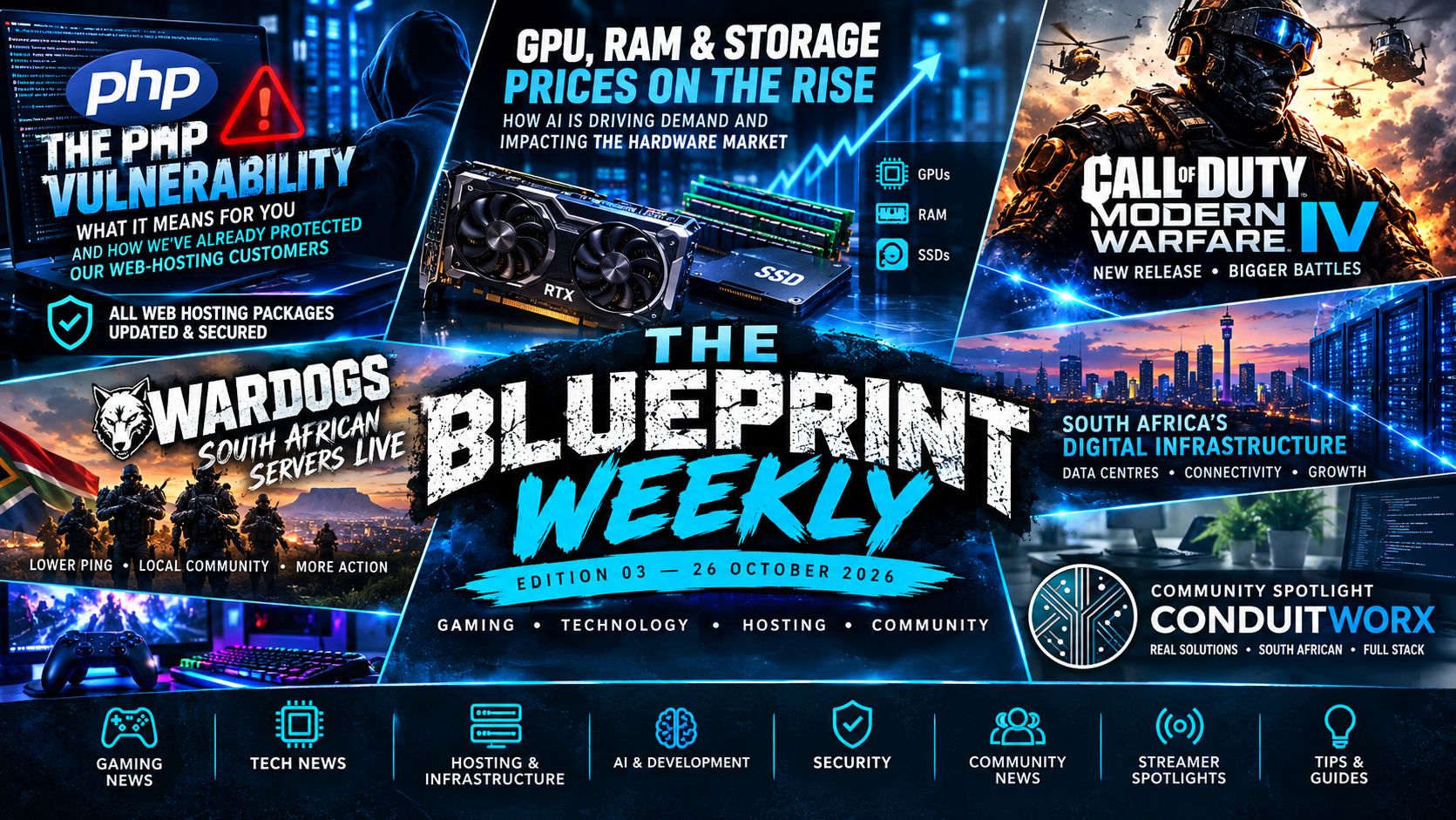
The BluePrint Weekly — Edition 03 — 26 October 2026
Gaming • Technology • Hosting • Community
Welcome to Edition 03 of The BluePrint Weekly.
This week has been a particularly interesting one for anyone involved in websites, hosting, servers or PC hardware.
A serious PHP security vulnerability made headlines across the technology industry, forcing organizations around the world to urgently patch their web servers.
At the same time, the effects of the AI boom are becoming increasingly visible in something many people probably didn't expect: the price of ordinary computer hardware.
RAM is getting more expensive.
SSDs are getting more expensive.
Graphics cards are getting more expensive.
And behind much of it is the enormous amount of infrastructure being built to support AI.
So this week, we're looking at what happened, what it means for BluePrint customers, and why the hardware inside the computers we use is becoming an increasingly important story.
Security: The PHP Vulnerability That Caused a Global Scramble
PHP2Shell
On 20 October, the PHP development team announced that an emergency security release was coming to address two critical vulnerabilities in the PHP runtime.
The vulnerabilities were subsequently identified as:
- CVE-2026-109618
- CVE-2026-109619
Both were rated CVSS 4.0 — 9.2, placing them firmly in the critical category. More importantly, they could allow an unauthenticated attacker to achieve remote code execution on vulnerable PHP installations.
The affected PHP branches were:
- PHP 8.5 before 8.5.12
- PHP 8.4 before 8.4.27
- PHP 8.3 before 8.3.36
- PHP 8.2 before 8.2.35
The PHP project released the patched versions on 21 October.
And this wasn't simply a theoretical vulnerability.
Security researchers demonstrated attacks against the vulnerabilities, and security organisations began warning that publicly available technical information and proof-of-concept code could make exploitation considerably easier.
Some organisations even temporarily took systems offline while they worked on patching them.
How serious was it?
Very.
PHP is one of the most widely used technologies on the internet, particularly for websites and content management systems.
That means a vulnerability in the PHP runtime doesn't just affect developers.
It can affect:
- Websites
- WordPress installations
- Web applications
- Hosting servers
- Customer portals
- E-commerce platforms
- APIs
- Internal business applications
The vulnerability also highlighted something important about modern cybersecurity:
The software underneath your application can be just as important as the application itself.
You can have a perfectly secure WordPress installation, strong passwords and a carefully configured firewall, but if the runtime executing your PHP code contains a critical remotely exploitable vulnerability, the underlying platform still needs to be patched.
So What Happened at BluePrint Hosting?
This is the part we particularly want our customers to know about.
BluePrint Hosting has patched the affected PHP environments across our web-hosting platform.
All BluePrint Hosting web-hosting packages have been updated to protect against the PHP vulnerabilities discussed above.
Our customers therefore did not need to individually patch the PHP runtime on the hosting platform for this particular vulnerability.
We take this kind of incident seriously because one of the reasons people use managed hosting is precisely so that they don't have to monitor every security advisory affecting the infrastructure underneath their website.
That doesn't mean customers can ignore security altogether.
Keeping WordPress, plugins, themes and other applications updated remains extremely important.
But when a vulnerability exists in the underlying hosting environment, we consider responding to it part of our responsibility as a hosting provider.
For reference, the official PHP security releases addressed the affected branches with PHP 8.5.12, 8.4.27, 8.3.36 and 8.2.35.
A separate warning about old PHP versions
There is another important distinction.
PHP 8.1 and older versions are already end-of-life and no longer receive security updates from the PHP project.
That is a separate issue from the two new vulnerabilities discussed above.
If you're running an old PHP version because an older application requires it, it is worth checking whether that application can be updated or migrated to a currently supported PHP version.
The Bigger Question: How Did This Happen?
One of the more unusual parts of this story is how the vulnerabilities were discovered.
Security researchers used AI-assisted techniques as part of their work identifying and validating the vulnerabilities.
Google's security team described the contribution of Gemini 4 Argon to vulnerability discovery, exploit development, attack detection and patch validation.
That creates an interesting twist.
We've spent years talking about AI helping developers write software.
We're now seeing AI being used to find vulnerabilities in software as well.
That means the cybersecurity arms race is increasingly becoming an AI-versus-AI problem.
The same technology that can help developers find bugs can potentially help attackers find them too.
And that makes keeping systems patched more important than ever.
Hardware Market: AI Is Eating More Than GPUs
If you've tried buying RAM, an SSD or a graphics card recently, you may have noticed something strange.
Prices aren't behaving like they normally do.
Computer hardware has historically followed a familiar cycle.
New technology launches.
Production increases.
Prices eventually fall.
Then the next generation arrives.
Right now, however, several parts of that cycle are being disrupted by the enormous demand coming from AI infrastructure.
And it isn't only GPUs.
RAM: Memory Has Become a Valuable Commodity
The DRAM market is under significant pressure.
TrendForce currently expects conventional DRAM contract prices to increase by around 10–15% quarter-on-quarter in Q4 2026, while AI-server demand continues to absorb significant production capacity.
Another October analysis expects DRAM contract prices to rise around 20% quarter-on-quarter in the fourth quarter, although forecasts vary depending on the type of memory being considered.
Why?
Because modern AI servers require enormous amounts of memory.
And the same broader memory manufacturing ecosystem supplies the DRAM used in:
- Servers
- Desktop PCs
- Laptops
- Gaming systems
- Workstations
- AI accelerators
AI doesn't necessarily consume your exact desktop RAM module.
But it competes for manufacturing capacity and advanced memory technologies.
The result is a supply chain where demand from large AI infrastructure projects can affect ordinary consumers.
And Then There Is HBM
One of the biggest reasons behind the memory crunch is High Bandwidth Memory, or HBM.
HBM is used alongside high-end AI accelerators and is designed to provide enormous memory bandwidth.
It is not the same thing as the DDR5 RAM in your PC, but it relies on closely related memory manufacturing and packaging capacity.
AI accelerators increasingly depend on large amounts of HBM to keep their processors supplied with data.
TrendForce reports that much of next year's HBM supply is already being contracted, while manufacturers continue expanding capacity and advanced packaging.
This is one reason the AI hardware story is no longer simply:
"NVIDIA needs more GPUs."
It is:
"The entire infrastructure surrounding those GPUs needs to scale."
Storage Is Getting Hit Too
The other part of the story is NAND flash.
NAND is the technology behind most modern SSDs.
And the market is tightening here as well.
TrendForce's latest market analysis projected 15–20% quarter-on-quarter growth in NAND Flash contract prices in Q4 2026, with enterprise SSDs experiencing particularly strong demand from cloud service providers.
That is significant because AI infrastructure requires enormous amounts of storage.
Think about the data involved:
Training datasets.
Model checkpoints.
Logs.
Vector databases.
Inference data.
Backups.
Temporary processing data.
And increasingly large AI models.
An AI data centre isn't just a collection of GPUs.
It is also a huge storage system.
And that storage needs to be extremely fast.
South Africa Is Feeling It Too
This isn't just something happening in the United States or Europe.
South African hardware prices are being affected as well.
A recent comparison by MyBroadband found that a comparable mid-range gaming PC was around 21% more expensive in 2026 than the previous year.
The biggest increases were seen in RAM and SSD storage.
In their comparison, a 16GB DDR4 kit that previously cost R699 had reached R2,299 at the time of their analysis.
The same report also found that South African distributors had reported significant increases in memory, SSD and GPU pricing.
Local pricing is affected by more than the global component price, of course.
Exchange rates, shipping, distribution and local stock levels all play a role.
But the global memory shortage is clearly becoming visible in the South African market.
GPUs: The Other Side of the Problem
And then we get to the component most people associate with AI:
the GPU.
There are effectively two GPU markets at the moment.
Consumer GPUs
These are the graphics cards gamers buy.
And they are being affected by the memory shortage.
Recent pricing analysis found significant increases across NVIDIA, AMD and Intel graphics cards, with some NVIDIA cards selling well above their original MSRP.
That is a frustrating situation for gamers.
A graphics card isn't only competing with other gamers anymore.
It is part of a global computing ecosystem where enormous amounts of capital are being spent on AI infrastructure.
Data-centre GPUs
The other market is much more extreme.
High-end accelerators such as NVIDIA's H100, H200, B200 and B300 are being deployed into large AI clusters.
Recent GPU infrastructure data shows that demand for newer Blackwell-generation hardware remains strong, while GPU rental prices have also remained elevated. One Q4 market analysis found median H100 rental prices up year-on-year and identified memory and advanced packaging rather than the GPU dies themselves as a major bottleneck.
NVIDIA itself has reported strong demand for its data-centre products and has acknowledged supply constraints while ramping both Blackwell and newer Vera Rubin systems.
This is why buying or renting AI GPU capacity has become an infrastructure story rather than simply a graphics-card story.
So When Will Prices Come Down?
That's the difficult question.
And unfortunately, there isn't a simple answer.
Manufacturers are increasing production and investing in new capacity.
But building semiconductor fabs and advanced packaging facilities takes time.
At the same time, AI infrastructure spending continues to increase.
IDC expects AI infrastructure demand to keep memory markets tight into 2027.
There are also signs that the market could eventually rebalance as additional production comes online.
But for now, anyone building a new server or gaming PC needs to take memory and storage costs seriously.
What Does This Mean for Hosting?
This is where the story becomes particularly relevant to us.
A hosting company is effectively buying the same fundamental resources that everyone else is competing for.
CPU.
RAM.
Storage.
Networking.
GPUs.
And when the cost of those components increases, eventually the industry has to deal with that reality.
But there is another side to the story.
Hardware utilisation becomes increasingly important.
If memory is expensive, wasting memory becomes more expensive.
If storage is expensive, inefficient storage becomes more expensive.
If GPUs are expensive, keeping them idle becomes extremely expensive.
This makes infrastructure optimisation increasingly important.
Instead of simply throwing more hardware at a problem, businesses need to ask:
Are we actually using the hardware efficiently?
That applies to everyone from a home lab enthusiast to a large data centre.
Gaming: The Busy End of 2026
The gaming industry isn't slowing down either.
October has been packed with major releases, with Call of Duty: Modern Warfare 4 arriving on 23 October alongside a long list of other releases.
And November is shaping up to be even bigger, with Grand Theft Auto VI currently scheduled for November.
For South African gamers, the continued growth of the local gaming market is also encouraging.
Recent industry estimates put South Africa's video-game market at around R5.55 billion for 2026, showing just how significant gaming has become locally.
That means more players.
More communities.
More creators.
More game servers.
And more demand for infrastructure that performs well from South Africa.
A Small South African Game Worth Checking Out
Not every interesting gaming story needs to involve a multi-billion-dollar studio.
A South African developer recently released Lekka Moments, a web game celebrating 23 moments from South African history and culture.
The game includes references ranging from the 2010 football World Cup to Siya Kolisi lifting the Rugby World Cup.
It is a good reminder that game development doesn't always require a massive studio.
Sometimes a developer with an idea can simply build something and put it out into the world.
And that's something we would like to see more of.
What This Means for You
There is a common thread connecting almost everything we've covered this week.
Technology is becoming more powerful, but the infrastructure required to support it is becoming more demanding.
AI is consuming enormous amounts of compute.
That compute needs memory.
It needs storage.
It needs networking.
It needs electricity.
It needs cooling.
And it needs people capable of managing all of it.
At the same time, the software running on those systems needs to remain secure.
The PHP vulnerabilities are a perfect example.
A security issue can appear in software that has been running reliably for years.
When that happens, the ability to respond quickly matters.
BluePrint Hosting: Our Approach
This week's PHP incident is also a good example of why we believe hosting should be more than simply renting someone a server and leaving them to figure everything else out.
We don't expect every customer to be a Linux administrator, security researcher or infrastructure engineer.
When a critical vulnerability affects the hosting environment, we monitor it, assess the impact and take action.
For the current PHP2Shell vulnerabilities, the affected PHP environments on our web-hosting platform have been upgraded and patched.
Our customers can continue focusing on their websites and businesses without having to manually deal with the underlying PHP runtime update for this incident.
Of course, keeping your own applications updated is still important.
Your WordPress installation, plugins, themes and custom applications are ultimately your responsibility.
But the infrastructure underneath them is ours.
And we think that distinction matters.
Final Thoughts
This week's stories might seem unrelated at first.
A PHP vulnerability.
Expensive RAM.
Rising SSD prices.
GPU shortages.
AI data centres.
New games.
South African developers.
But they're all connected by one thing:
Infrastructure.
The software we use depends on hardware.
The hardware depends on manufacturing capacity.
Manufacturing capacity is increasingly being influenced by AI.
And everything ultimately depends on infrastructure being maintained, secured and operated properly.
That is the part of technology that often goes unnoticed.
When everything works, nobody thinks about it.
When something breaks, suddenly everyone does.
That's why we'll keep talking about the technology behind the technology.
Because whether you're running a website, hosting a game server, building an application, developing a game or simply playing one, the infrastructure underneath it all matters.
Community Spotlight: ConduitWorx
Building software that solves real problems
Technology has a habit of making things sound more complicated than they really are.
Artificial intelligence. APIs. Databases. Cloud platforms. Mobile applications. Automation. Integrations.
For a business owner, however, the question is usually much simpler:
"Can this solve my problem?"
That idea sits at the centre of ConduitWorx, a South African software development company building websites, web platforms, mobile applications and desktop software.
Their philosophy is straightforward: software should serve a purpose.
Rather than simply building whatever features a client asks for, ConduitWorx tries to understand the problem behind the request and then determine what the right solution should look like.
As they put it:
"The requested feature isn't always the actual solution."
That philosophy runs through much of the company's work.
Connecting the pieces
Even the name ConduitWorx reflects this approach.
A conduit connects things and allows them to work together. For the team, that represents connecting people, systems and ideas into one functioning solution.
The "Worx" represents the practical work involved in making those connections happen.
And that is important because real-world business problems rarely fit neatly into a single technology category.
A business might need a website.
But perhaps that website also needs to communicate with a database.
That database may need to connect to a mobile application.
The mobile application might need to communicate with a business platform.
And somewhere in the middle there may be physical hardware that also needs to communicate with the software.
ConduitWorx deliberately takes a broad approach because, in their words, real-world problems don't fit neatly into one category.
Their current work spans web platforms, websites, mobile applications, desktop software, security and even 3D development.
Their philosophy is essentially:
One problem. One team. The right combination of technology.
Start With the Problem
One of the strongest themes that came through in our conversation was ConduitWorx's problem-first approach.
The team explained that simply building the requested feature can sometimes solve one small part of a problem while leaving the real frustration untouched.
Understanding how a business actually operates can change the solution entirely.
That means looking at the people using the system, the existing processes, the information moving between systems and the points where things currently slow down.
Only then does the question become:
What should we build?
It is a surprisingly important distinction.
There is a difference between digitising a process and actually improving it.
Titan: When Software Meets the Physical World
One of the best examples of this philosophy is Titan, ConduitWorx's weighbridge and scrap-metal purchasing software.
At first glance, a weighbridge application might sound fairly straightforward.
A truck arrives.
The vehicle is weighed.
The weight is recorded.
A ticket is produced.
But the real-world process is considerably more complicated.
Titan connects directly to the scale, handles gross, tare and net weights, applies pricing, captures supporting evidence and prints tickets. It also integrates with hardware such as cameras and printers.
Instead of simply recording a number, the software handles the broader workflow.
That was one of the projects ConduitWorx identified as particularly memorable because it required software to interact reliably with physical hardware.
And that introduces an entirely different set of challenges.
A website can sometimes tolerate a brief delay.
A business-critical weighbridge system cannot simply decide that it isn't going to communicate with the scale today.
The software needs to work in the real world.
That is precisely the kind of problem ConduitWorx seems to enjoy solving.
Custom Software Doesn't Have to Mean Complicated Software
There is a common perception that custom software is automatically expensive, complicated and only appropriate for large corporations.
ConduitWorx sees it differently.
A custom solution doesn't necessarily need to start as a massive platform.
It can begin by solving one specific problem and grow from there.
The important question isn't:
"Can we build custom software?"
It is:
"Will building something specifically for this problem create enough value to justify it?"
For a business drowning in repetitive administration, disconnected systems or manual data entry, the answer may be yes.
Custom software can potentially automate repetitive work, bring information together, improve visibility and give employees tools that actually fit the way they work.
The goal isn't technology for technology's sake.
The goal is a better process.
AI: A Tool, Not a Replacement for Engineering
With AI becoming one of the biggest stories in software development, we asked ConduitWorx how they think it will affect the industry.
Their answer was particularly relevant to this week's edition of The BluePrint Weekly.
They see AI making development faster and helping developers solve problems more efficiently.
But they don't see generating code as the same thing as building reliable software.
Someone still needs to understand the requirements.
Someone needs to make architectural decisions.
Security needs to be considered.
The resulting code needs to be tested.
And, perhaps most importantly, someone needs to determine whether the finished product actually works in the real world.
Their view is that AI is both a development tool and a fundamental change to how software companies operate.
The important distinction is that they see AI as something that should enhance engineering judgement rather than replace it.
Their area of particular interest is AI combined with practical automation.
The possibility of connecting systems and removing repetitive work could be especially valuable to smaller businesses that don't have large teams to handle administration.
Security From Day One
Security is another area where ConduitWorx takes a "build it in" approach.
Rather than treating security as something added after development, the team says it needs to be considered from the beginning.
That includes access controls, data protection, encryption, validation and the way different systems communicate.
Their portfolio currently includes Sentinel, a zero-knowledge password manager available through browser and desktop clients, as well as business platforms with role-based access, authentication and audit logging.
Their approach is consistent with their broader philosophy:
Security isn't an optional feature bolted onto the finished product.
It is part of designing the product correctly.
More Than Just Business Software
One of the things that makes ConduitWorx particularly interesting is the variety of problems they are working on.
Their portfolio includes:
Breach — a business management and support platform bringing together support tickets, email, scheduling, documents, invoicing and stock management.
Titan — software connecting weighbridge hardware with business processes.
LifeBeacon — an emergency SOS mobile application connecting users and emergency response organisations.
Sentinel — a zero-knowledge password manager.
Mooirivier — an offline-first scheduling application designed to continue working when connectivity disappears.
They also build websites and other web platforms for clients across different industries.
These projects don't appear to have much in common at first.
But there is a common thread.
Each one starts with a problem.
Each requires understanding the people who use it.
And each requires choosing the technology based on what the solution actually needs.
Building a Business While Building Software
Starting a software company isn't simply about writing code.
That was one of the lessons ConduitWorx highlighted when we asked about the biggest challenge of building the company.
Development is only one part of the job.
There is client communication.
Planning.
Project management.
Costs and timelines.
Support.
Business development.
And trying to build something for the future while still delivering what needs to be done today.
The team described it as a continuous learning process.
Technical ability matters, but so do discipline, planning, communication and adaptability.
That is a lesson that applies far beyond software development.
A technically excellent product isn't enough if the requirements were misunderstood or the project wasn't managed properly.
The People Behind the Code
We also wanted to know what drives the people behind ConduitWorx.
The answer was refreshingly simple.
They enjoy taking an idea, working through a problem and eventually turning it into something real that people can use.
When a difficult project comes along, they describe the process almost like solving a giant puzzle.
Some pieces don't fit.
You try something else.
You learn.
You keep working.
Eventually, the solution starts to become clear.
They quoted Frank Tyger:
"Ambition is enthusiasm with a purpose."
That seems like a fitting description for a company still building its own story.
And Yes — They're Gamers
Of course, we couldn't finish a Community Spotlight without asking what happens when the team isn't working.
The answer?
They are gamers at heart.
When they're not stuck behind screens working or gaming, they apparently spend their time doing the usual things:
Eating.
Sleeping.
And annoying their wives.
And, according to the team, perhaps even feeding the trolls in the dungeon.
Although they were quick to clarify that they don't actually have a dungeon.
Yet.
They also have an arcade section on their website, which is worth checking out if you want to see the more playful side of the company.
What's Next for ConduitWorx?
Looking three to five years ahead, the goal isn't simply to become a bigger software development company.
ConduitWorx wants to become a trusted company known for building practical, reliable products that businesses can depend on.
They want to build lasting relationships with clients while also developing more of their own products.
And their ultimate idea is particularly ambitious:
A connected platform bringing together business operations, automation and AI.
The idea is to connect the many systems businesses already use so that less time is spent moving information between them and more time can be spent actually growing the business.
It is a problem many businesses can relate to.
You have one system for customers.
Another for accounting.
Another for documents.
Another for communication.
Another for reporting.
Each system might work perfectly well on its own.
But the gaps between them create work.
That is exactly the kind of problem ConduitWorx wants to solve.
The ConduitWorx Philosophy
After going through their answers, one idea kept coming back:
Build things people genuinely need.
It is easy to become obsessed with programming languages, frameworks and the latest technology.
Those things matter.
But they are tools.
The real value comes from understanding people and solving problems.
ConduitWorx's advice to anyone wanting to start a software development company reflects that:
"Focus on solving real problems, keep learning and don't underestimate the business side of development."
It is probably advice worth listening to whether you're building software or building almost anything else.
Where to Find ConduitWorx
If you have an idea, a business problem or simply a process that you think could work better, ConduitWorx says you can approach them with the problem and work through the solution together.
You can learn more about them here:
Email: info@conduitworx.co.za
Phone / WhatsApp: +27 60 614 9635
They're also active on social media:
Our Take
What stood out to us about ConduitWorx wasn't the number of technologies they work with.
It was the reason behind that variety.
They're not trying to use every technology simply because it exists.
They're trying to understand the problem first and then work out what combination of technology makes sense.
And perhaps that's a lesson worth carrying into the wider technology industry.
The best technology isn't necessarily the newest technology.
Sometimes it's simply the technology that solves the problem properly.
That's what makes ConduitWorx a fitting Community Spotlight for this edition of The BluePrint Weekly.
This is The BluePrint Weekly.
Gaming • Technology • Hosting • Community