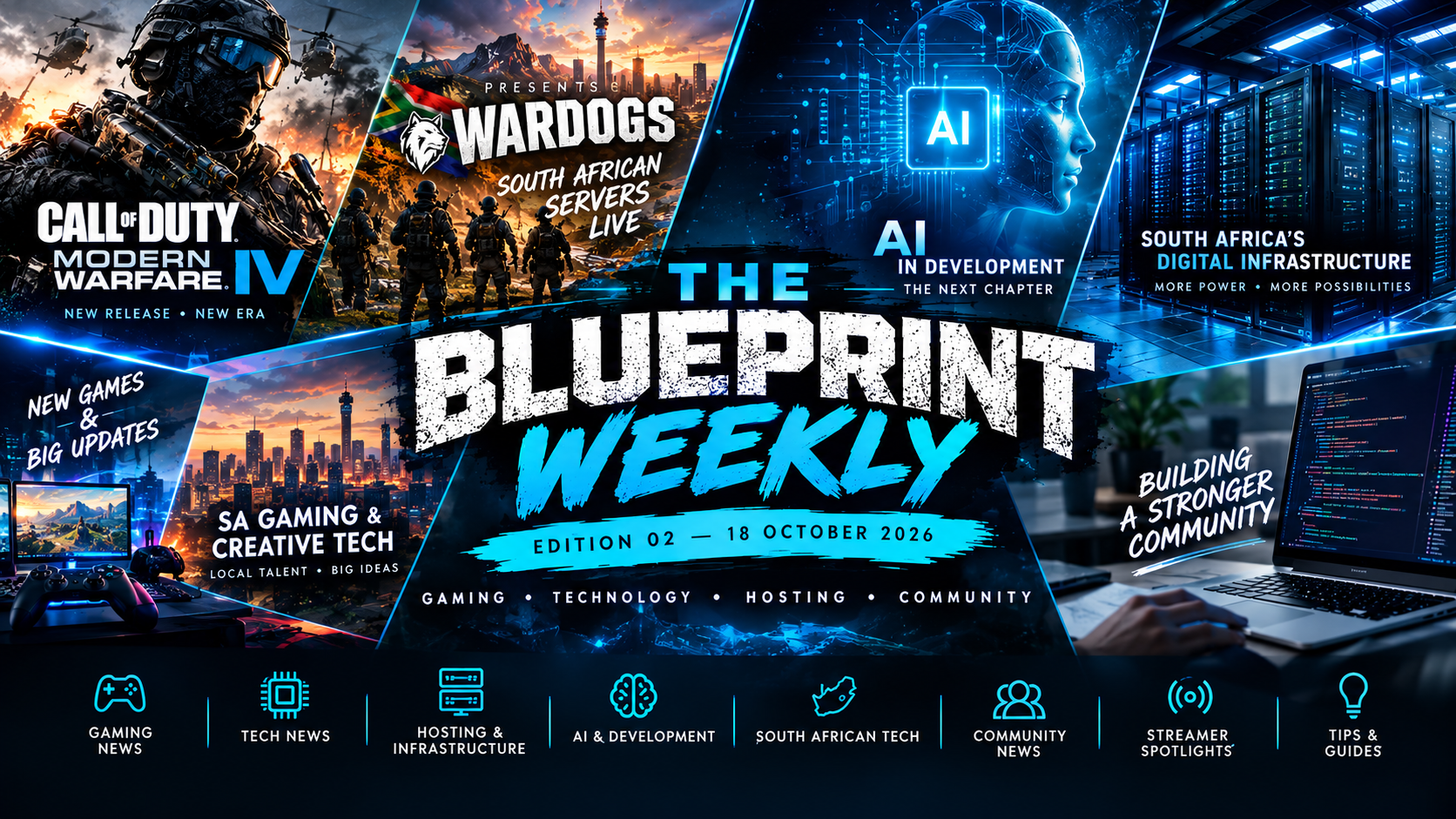
The BluePrint Weekly
Gaming • Technology • Hosting • Community
Edition 02 — 18 October 2026
Welcome to Edition 02 of The BluePrint Weekly.
Last week we officially launched the BluePrint Weekly with a look at AI-powered game development, the South African gaming scene, WARDOGS, and our first Community Spotlight featuring Hexacode.
This week, we're looking at something that has become increasingly difficult to ignore: the pace at which technology is changing.
AI is moving from something people experimented with into something developers and businesses are actively building around. Gaming is entering another busy release period. South Africa continues to see investment in data-centre and digital infrastructure, while local communities are proving that there is a real demand for technology built and hosted closer to home.
So, let's take a look at what's happening.
Technology This Week
AI is becoming a development tool, not just a chatbot
Artificial intelligence has been moving quickly over the past few years, but the latest developments are increasingly focused on what AI can actually do rather than simply what it can tell us.
Google recently launched Gemini 4 Argon, its latest flagship AI model aimed at developers and businesses. The model is designed for more complex, multi-step tasks including coding, cybersecurity, finance and scientific work.
That shift is important.
The conversation around AI has often been framed as:
"Will AI replace developers?"
A more interesting question might be:
"What will developers be able to build when AI becomes another tool in their toolbox?"
We are already seeing developers use AI to generate code, investigate problems, create documentation, prototype ideas and automate repetitive work.
That doesn't necessarily eliminate the need for developers.
If anything, it puts more emphasis on understanding what should actually be built in the first place.
Writing code is only one part of software development. Understanding a customer's problem, designing a solution, making sensible architectural decisions, securing the system and maintaining it afterwards are still very human problems.
For smaller developers and businesses, this could be particularly interesting.
A person with a good idea may now be able to prototype something that previously would have required a much larger development team.
The challenge will be turning that prototype into something that is reliable, secure and actually useful.
Gaming News
Modern Warfare 4 arrives this week
October is turning into a particularly busy month for gamers.
Call of Duty: Modern Warfare 4 is scheduled to launch on 23 October 2026, continuing Activision's major yearly release cycle. The game is expected to launch across PlayStation 5, Xbox Series X|S and PC, with Nintendo Switch 2 also joining the platform lineup.
But there is already another interesting development surrounding the franchise.
Activision has confirmed that the 2027 Call of Duty will introduce another new sub-franchise, rather than continuing with another Modern Warfare or Black Ops entry.
According to Activision's marketing lead, this is partly a response to players wanting something that feels genuinely different rather than another iteration of an established series.
Whether that change is enough to satisfy the community remains to be seen.
For players, however, the next few months should be interesting.
WARDOGS: South African servers become a reality
One of the stories we touched on in Edition 01 has developed considerably.
When we previously mentioned the possibility of South African WARDOGS servers, the information was largely coming from the local community rather than being presented as an official Bulkhead announcement.
That situation has now changed.
With the launch of WARDOGS Season 2 on 15 October, South African community servers have started appearing locally. Community reports indicate that servers have moved onto South African hosting, giving local players a significantly lower-latency option than connecting to Europe.
A South African community petition calling for official local WARDOGS servers also passed 1,100 verified signatures before Season 2 launched.
There is an important distinction here:
Community-hosted South African servers are not the same thing as official Bulkhead-operated South African servers.
The official WARDOGS server infrastructure and community-server programme are still controlled by the game's developers and approved hosting arrangements.
Nevertheless, this is a great example of something we like seeing in the South African gaming community.
Players identified a problem.
The community organised around it.
And local infrastructure eventually followed.
That is exactly the kind of story worth watching.
Hosting & Infrastructure
South Africa continues to build its digital infrastructure
Gaming isn't the only area where local infrastructure matters.
South Africa continues to attract investment into data centres, connectivity and digital infrastructure.
A recent development saw Continent 8 Technologies announce a new data centre in Johannesburg, expanding its managed technology, connectivity, cloud and cybersecurity services into the African market.
At the same time, the growth of AI is creating a new challenge for the data-centre industry.
AI workloads require significant computing resources, networking capacity, power and cooling. South Africa already has a growing data-centre ecosystem, but energy availability and other infrastructure constraints remain important considerations.
This is something that is easy to overlook when we talk about AI.
AI might appear to exist entirely inside an application or web browser, but behind that interface are enormous amounts of physical infrastructure.
- Servers
- Storage
- Networking
- Power
- Cooling
- Data Centres
- Copper and Fibre Cabling
And people maintaining all of it.
The more digital services we use, the more important that underlying infrastructure becomes.
South Africa's Gaming and Creative Technology Scene
Technology isn't only being built in traditional tech companies
South Africa's technology scene continues to stretch well beyond conventional software companies.
The Fak'ugesi Festival recently unveiled its 2026 programme, including game jams, XR experiences, installations, hackathons, exhibitions and other technology and creative projects.
That is encouraging because it shows another side of technology development.
Not everything has to be a billion-rand startup.
Some of the most interesting projects begin with a developer, artist, gamer or small group of people experimenting with an idea.
That is also one of the reasons we started The BluePrint Weekly.
There are plenty of people in South Africa building interesting things who aren't necessarily getting the attention that large technology companies receive.
We want to help change that.
What Does This Mean for Gamers and Developers?
There is a common thread running through many of this week's stories.
Infrastructure is becoming more accessible, while the tools for creating things are becoming more powerful.
AI is lowering the barrier to software development.
Game engines and development platforms continue to become easier to use.
Local communities are creating their own gaming infrastructure.
South African developers are building applications for local businesses and international audiences.
And data-centre infrastructure continues to expand.
That doesn't mean everything is suddenly easy.
In many ways, the opposite is true.
When everyone has access to powerful tools, having a good idea isn't enough anymore.
Execution matters.
Understanding the problem matters.
Security matters.
Performance matters.
And perhaps most importantly, knowing who you're building something for matters.
A Thought From BluePrint
One thing we've learned from working with hosting customers is that technology is rarely the difficult part by itself.
Getting a server running is one thing.
Knowing why you're running it, who needs it, what it needs to handle and how it should grow is another.
The same applies to websites, applications, game servers and infrastructure.
You don't always need the biggest server.
You don't always need the newest technology.
And you don't always need the most complicated solution.
Sometimes you just need the right solution for the problem.
That is something we'll continue coming back to in future editions.
No Community Spotlight This Week
We don't have a Community Spotlight for this edition.
And that's intentional.
We don't want to turn the spotlight into something we simply have to fill every week.
When we feature a person, developer, streamer, business or community, we want there to be an actual story worth telling.
The Community Spotlight will return when we find someone with something interesting to share.
In the meantime, we're still looking.
If you're building something, developing a game, running a community, streaming, creating content, developing software or growing a small business, we'd love to hear from you.
You don't need thousands of followers.
You don't need to be a large company.
Sometimes the most interesting stories come from people who are still at the beginning of their journey.
Final Thoughts
Technology is moving quickly.
AI is changing how software is created.
Gaming communities are becoming more involved in the infrastructure supporting their games.
South African developers and creators continue to build new things.
And behind all of it is an increasingly important layer of infrastructure keeping everything connected.
That makes this an interesting time to be involved in technology.
Whether you're a gamer, developer, business owner, streamer, creator or just someone who enjoys seeing what people are building, there is a lot happening.
And we'll be here next week to see what happens next.
This is The BluePrint Weekly.
Gaming • Technology • Hosting • Community