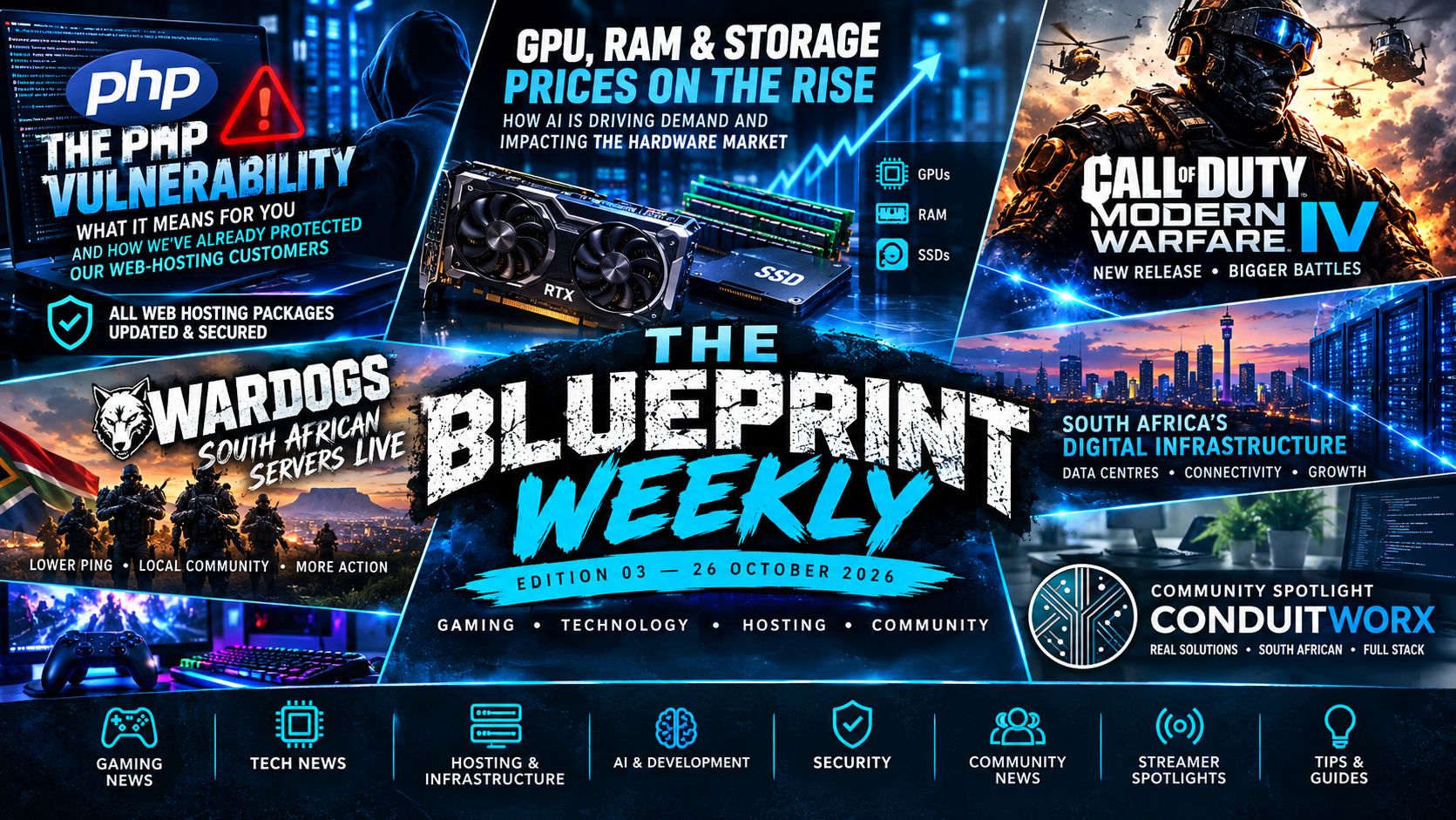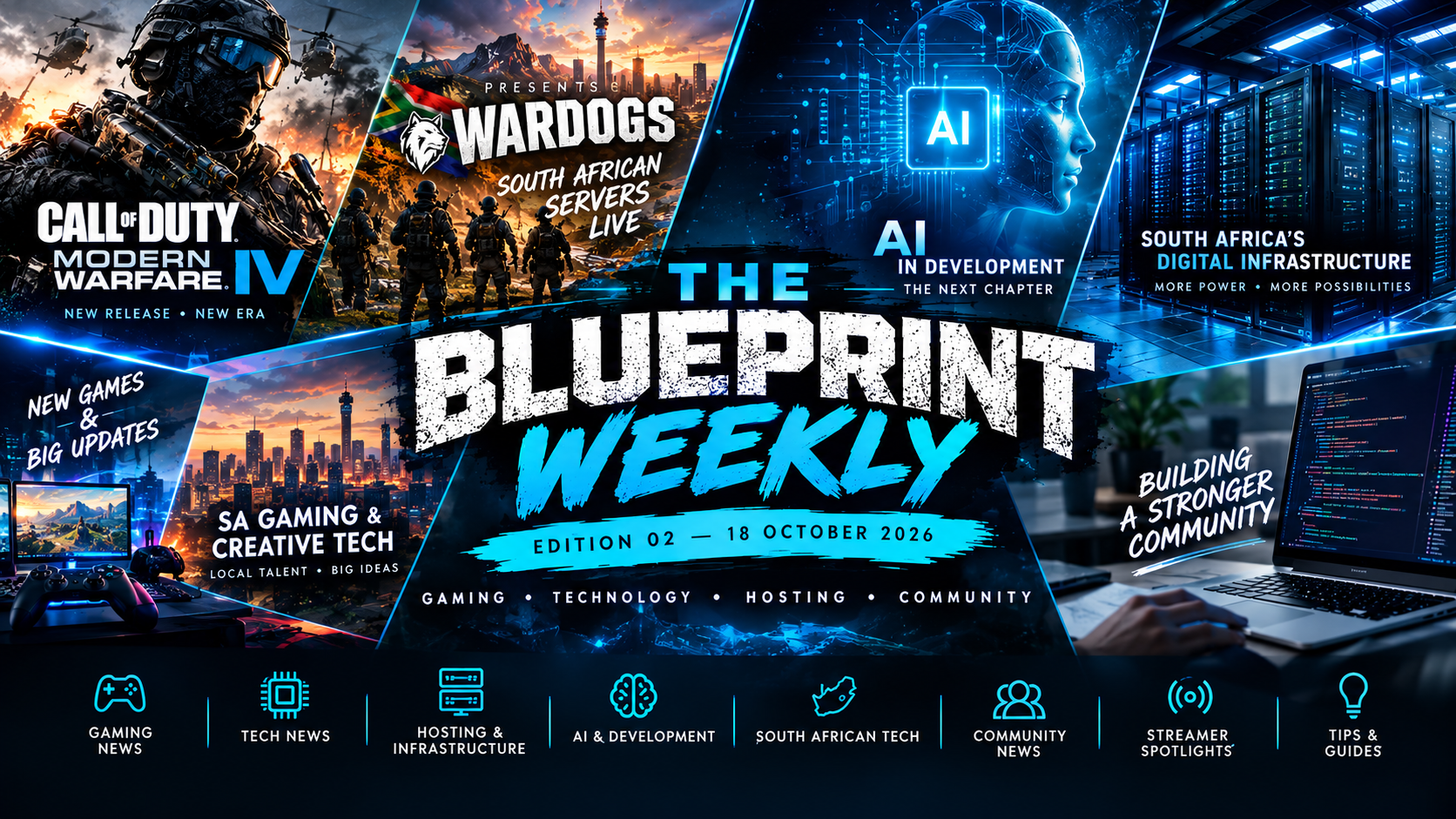
The BluePrint Weekly
Gaming • Technology • Hosting • Community
Edition 01 — 9 October 2026
Welcome to the very first edition of The BluePrint Weekly.
If you're reading this, you may be wondering what exactly we've decided to start here.
The simple answer is: we want to build something useful.
BluePrint Hosting has always been about more than putting a server online. We work with gamers, communities, developers, businesses, creators and people who are building something of their own.
We thought it was time to create a place where we could share some of the things we're seeing, learning and getting excited about.
Every week, we'll be looking at what's happening across technology, gaming, hosting and the wider digital world.
But there's another important part to this.
This isn't just about BluePrint
We don't want this blog to become another company newsletter where every article eventually ends with "buy our product."
There are plenty of places on the internet where you can read advertising disguised as news.
That's not what we're trying to create.
Instead, we'd like to use this platform to help other people grow too.
That could mean introducing you to a streamer you've never heard of, highlighting a gaming community, talking to a developer about something they're building, or introducing a small business that is just getting started.
If someone in our community is doing something interesting, we want to give them a platform.
Because we believe a good partnership should work both ways.
If BluePrint helps someone grow, and that person helps BluePrint grow, everyone wins.
And sometimes the benefit doesn't need to be immediate. Sometimes it's simply about giving someone an opportunity to be seen.
Technology is making game development more accessible
One of the most interesting developments this week comes from Google.
Google has launched Playground, an experimental gaming platform that allows users to create, play and share custom games using natural-language prompts rather than traditional programming. Google says users can describe their ideas through text prompts, share their creations with friends or publish them to a community gallery. Multiplayer games and leaderboards are also supported, with Unity Spark planned as a future addition for more advanced game creation.
Why is this interesting?
Because lowering the technical barrier to creating something doesn't necessarily mean fewer developers.
It could mean more people become creators.
Someone with a great game idea but no programming experience can now experiment with that idea in a way that simply wasn't practical before.
The really interesting question is what happens next.
What happens when some of those people move from experimenting with AI-generated prototypes to building proper games, communities and multiplayer experiences?
That's where development, infrastructure and hosting start becoming interesting again.
A prototype running in a browser is one thing.
A game with hundreds or thousands of players is another.
And that's a space we'll be watching closely.
South African developers are making their mark
It's also important to look closer to home.
South Africa and the broader African gaming industry continue to produce developers and studios worth watching.
This week, South African studio Clockwork Acorn released the Feather's Edge demo on Steam. Clockwork Acorn describes itself as a South African independent game development studio, and its current projects include Feather's Edge and Jetstream.
This is exactly the kind of development we want to highlight.
We aren't interested in only talking about what Silicon Valley, Europe or the big international publishers are doing.
There are people here in South Africa building games, websites, software, communities and businesses.
We want to hear from them.
WARDOGS: Could South African servers be coming?
Here's one that caught our attention this week.
The South African WARDOGS ZA community has shared an announcement indicating that two South African-hosted WARDOGS servers could be going live with the launch of Season 2 on October 15.
According to the announcement shared in the WARDOGS ZA Discord, the community is expecting two 100-player servers, hosted in Johannesburg.
There is an important distinction here.
This announcement comes from the South African WARDOGS community and is not, at the time of writing, an official announcement from the WARDOGS developers.
However, it is not happening in isolation.
WARDOGS officially announced that Season 2 is launching on October 15, 2026. The developers have also acknowledged that community servers are an important part of the game and have been making changes to improve community-server discoverability, including better filtering, text-based server search and persistent community-server IDs.
The South African community is currently reporting that its servers will move to South African hosting for the Season 2 launch. That information is coming from the community itself, rather than directly from the developer, so we'll continue to treat the server announcement as community information until the developers confirm it themselves.
Why does this matter?
For South African players, local infrastructure can make a substantial difference.
According to measurements published by the South African WARDOGS community, players connecting from South Africa to European servers can experience latency in the region of 180–220 ms. A locally hosted community server could potentially bring that latency down considerably for South African players.
For a fast-paced multiplayer shooter, that difference can be very noticeable.
If the WARDOGS ZA announcement proves correct, October 15 could therefore be an important day for the South African WARDOGS community.
We'll be watching this one closely.
If the servers go live as announced, we'll follow up in a future edition and see how the South African community responds.
Modern Warfare 4 is almost here
Another major gaming release is approaching.
Call of Duty: Modern Warfare 4 is scheduled to launch on October 23, 2026. Activision has also confirmed that PC players who digitally pre-purchase the game can preload from October 15, while Campaign Early Access begins October 16.
For us, major releases like this are always interesting from a server and infrastructure perspective.
Large game launches aren't just about the game itself. Behind the scenes there is an enormous amount of infrastructure supporting authentication, matchmaking, downloads, updates, telemetry and the wider player ecosystem.
And that's something we'll be talking about more in future editions:
What actually happens behind the scenes when millions of people want to play something at the same time?
Our first Community Spotlight
Community Spotlight: Hexacode
From 11 Years of Development Experience to Building Something of Their Own
For the first edition of The BluePrint Weekly, we wanted to start with a company that represents exactly what this feature is about: people who are building something of their own and taking the next step in their journey.
Our first Community Spotlight is Hexacode, a new South African software development company built on more than 11 years of hands-on development experience.
Behind Hexacode is a developer who decided that after more than a decade of working in the industry, it was time to take that experience and build something independently.
"After 11 years of working as a developer, I reached a point where I wanted to take ownership of the work I was doing and build something of my own."
That decision led to the creation of Hexacode.
Building What People Actually Need
One of the themes that comes through strongly when talking to Hexacode is the importance of solving real problems.
Starting a new technology company can be difficult, particularly when entering markets where established products and services already exist. Rather than trying to compete simply by creating another application, Hexacode's approach is to listen to what people are struggling with and build around those needs.
For the team behind Hexacode, one of the biggest lessons so far has been relatively simple:
Build what people need, rather than what you think they want.
That philosophy is particularly important when working with smaller businesses and startups.
Hexacode enjoys working with startups where applications can be developed from the ground up, as well as smaller businesses that may not have the budget for large, expensive software solutions.
The goal is to provide something practical and affordable that can help those businesses grow.
A Project With Bigger Ambitions
One of Hexacode's current projects is an application that integrates with mobile applications and websites, with the aim of making POS systems easier to use for multiple businesses.
The project is still under development, but it represents the direction Hexacode wants to take: rather than creating a solution for only one client, the aim is to develop something that can potentially serve multiple businesses with minimal changes between implementations.
That approach is also reflected in Hexacode's longer-term vision.
The company hopes to grow a team and develop services that can be used by multiple clients, creating applications that are scalable rather than being built exclusively around a single customer's requirements.
AI: A Tool, Not a Replacement
Like almost every area of software development, Hexacode has seen significant changes brought about by artificial intelligence.
But rather than viewing AI as something that will replace developers, Hexacode sees it as another tool in the developer's toolbox.
The founder believes developers who embrace AI will be able to build better products faster, while spending less time on some of the repetitive parts of development.
After 11 years in the industry, the difference is particularly noticeable.
Tasks that once involved manually searching for solutions, writing and testing large amounts of code, or spending considerable time finding bugs can now be assisted by AI tools.
That doesn't eliminate the developer's role. Instead, it gives developers more time to concentrate on functionality, usability and creating something that actually works well for the people using it.
"I don't believe AI is taking over a developer's role. For me, it's a tool to be used — one that enhances and helps a developer rather than replaces them."
It's a perspective we're likely to hear a lot more about as AI continues to change the development industry.
Starting Small and Planning Properly
Building a new company hasn't been without its challenges.
Hexacode's founder has seen previous ideas and businesses struggle because they entered markets that were already saturated or attempted to solve problems that weren't necessarily problems people needed solved.
That experience has influenced the way Hexacode approaches new projects.
Rather than rushing into development, the focus is increasingly on listening to potential customers, understanding their frustrations and identifying where software can genuinely make their lives easier.
Another important lesson has been to slow down and plan.
For a new company competing against established businesses, trying to do everything at once can be a recipe for problems.
Hexacode's approach is to build carefully, learn from experience and gradually develop the company rather than trying to become an established software house overnight.
Technology Has Always Been Part of the Journey
The interest in technology started long before Hexacode.
Growing up, the founder was fascinated by computers and technology and has continued learning as the industry has evolved.
That curiosity hasn't disappeared with the creation of the company.
Outside of work, time is still spent learning, experimenting and upskilling in programming and technology.
There is also a gaming connection.
Free time is often spent playing PC strategy games, where solving problems and finding the most effective solution are part of the experience.
It seems fitting for someone whose professional life revolves around solving problems with software.
Looking Ahead
The long-term vision for Hexacode is not simply to build one successful application.
The goal is to build a team, develop multiple services and create software that can be used by many businesses.
That means developing products that can scale while requiring as few changes as possible between clients.
It's an ambitious goal for a young company, but it is also one that builds on more than a decade of experience in software development.
And perhaps most importantly, Hexacode wants to help other people entering the technology industry.
The founder's own journey has involved years of learning, solving problems and seeing where software development could be done better.
Now, Hexacode wants to take that experience and use it to help other businesses and potentially other developers find their own path into the industry.
A Message to Future Developers
When asked what advice they would give someone thinking about starting their own development business, the answer comes back to experience and listening.
Build your experience.
Learn from what doesn't work.
Listen to your clients.
And look for the point where the software genuinely makes someone's life easier.
It's advice that applies well beyond software development.
Whether you're building a business, a gaming community, a streaming channel or your first application, understanding what people actually need is often more valuable than simply trying to build something impressive.
Connect With Hexacode
Hexacode is currently working on its website and communication channels.
For now, anyone interested in finding out more or discussing a potential project can contact the team directly at:
We're looking forward to seeing where Hexacode goes from here.
And perhaps, when we revisit this Community Spotlight in a year or two, we'll be able to look back at this first edition and see just how far they've come.
What's next?
This is only Edition 01.
Going forward, we'll be bringing you a mixture of:
- Gaming news and releases
- Hosting and infrastructure news
- New technology
- AI and development
- South African technology and gaming
- Customer stories
- Streamer and creator spotlights
- Useful tips and guides
- And occasionally, what's happening behind the scenes at BluePrint
We'll also occasionally ask people in our community for their opinions and experiences.
Because technology isn't built by companies alone.
It's built by people.
And we'd like to introduce you to some of them.
Want to be featured?
If you're a BluePrint customer, streamer, developer, gaming community, content creator or small business and you'd like to tell your story, get in touch with us.
You don't need thousands of followers.
You don't need to be famous.
You just need to be building something you're proud of.
We'll do our best to help you get it in front of more people.
Welcome to The BluePrint Weekly.